Cognitive Data Privacy Platform for Secure AI, Analytics, and Data Collaboration.
Enterprises today operate within a fundamental constraint — data is both their most valuable asset and their highest risk exposure.
Across industries such as healthcare, finance, telecom, and digital platforms, organizations generate and store massive volumes of sensitive data, including personally identifiable information (PII), protected health information (PHI), and financial records. While this data holds significant analytical and strategic value, its usage is increasingly restricted by privacy regulations, security risks, and the potential for re-identification.
This creates a structural limitation: organizations can either use their data and risk exposure, or restrict access and lose its value.
Traditional approaches have failed to resolve this problem. Basic anonymization techniques are reversible, synthetic data often lacks real-world utility, and infrastructure-heavy security models do not address the core issue — how to safely use data without exposing it.
The Entiovi Privacy Platform, powered by Xafe, addresses this challenge by fundamentally redefining how data is processed, shared, and analyzed.
Instead of treating privacy as an external control layer, Xafe embeds privacy directly into the data and computation lifecycle. It enables organizations to transform sensitive datasets into privacy-preserving, high-utility data environments that retain analytical value while ensuring strict privacy guarantees.
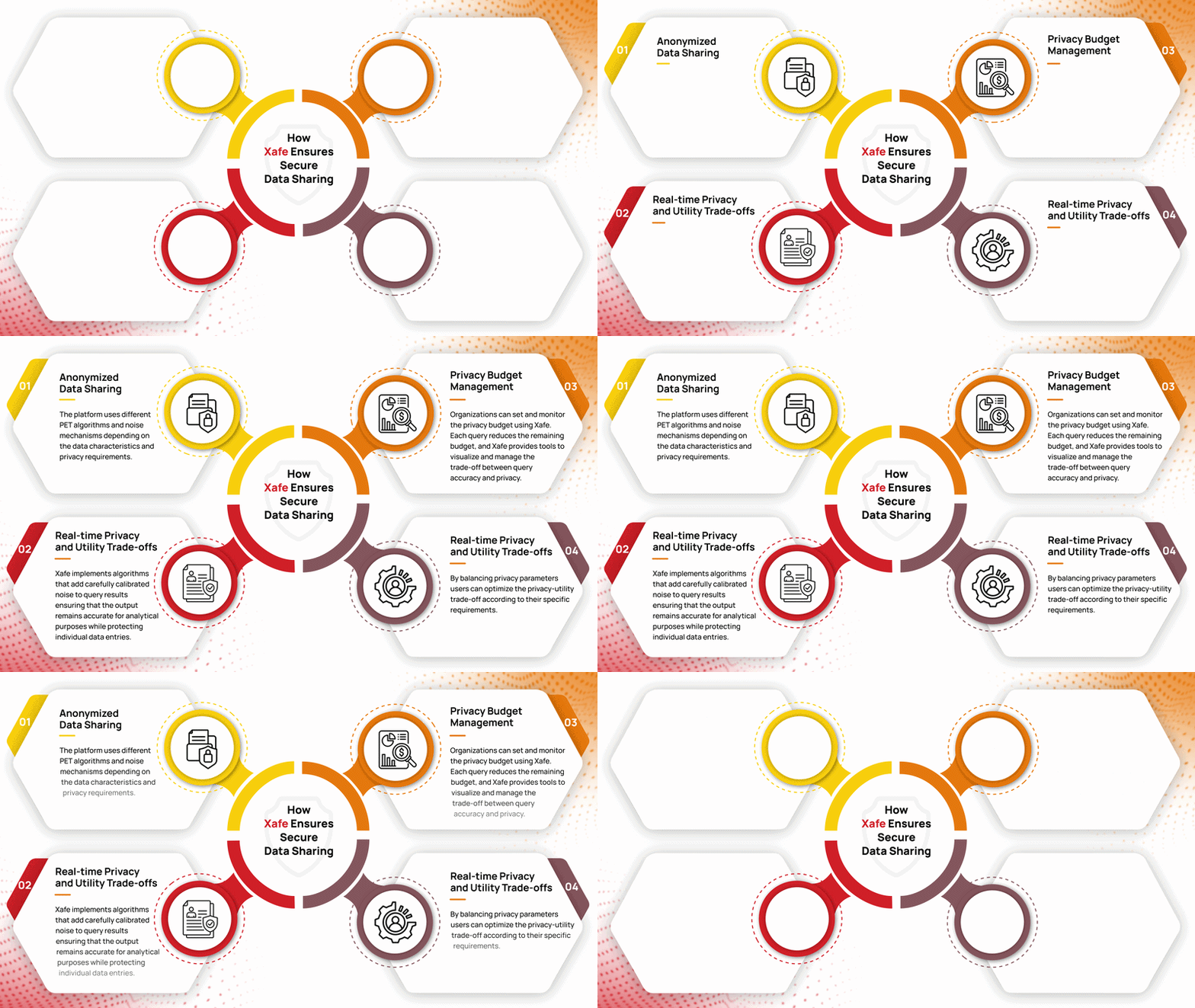
This approach ensures that data can be:
— all without compromising privacy or regulatory compliance.
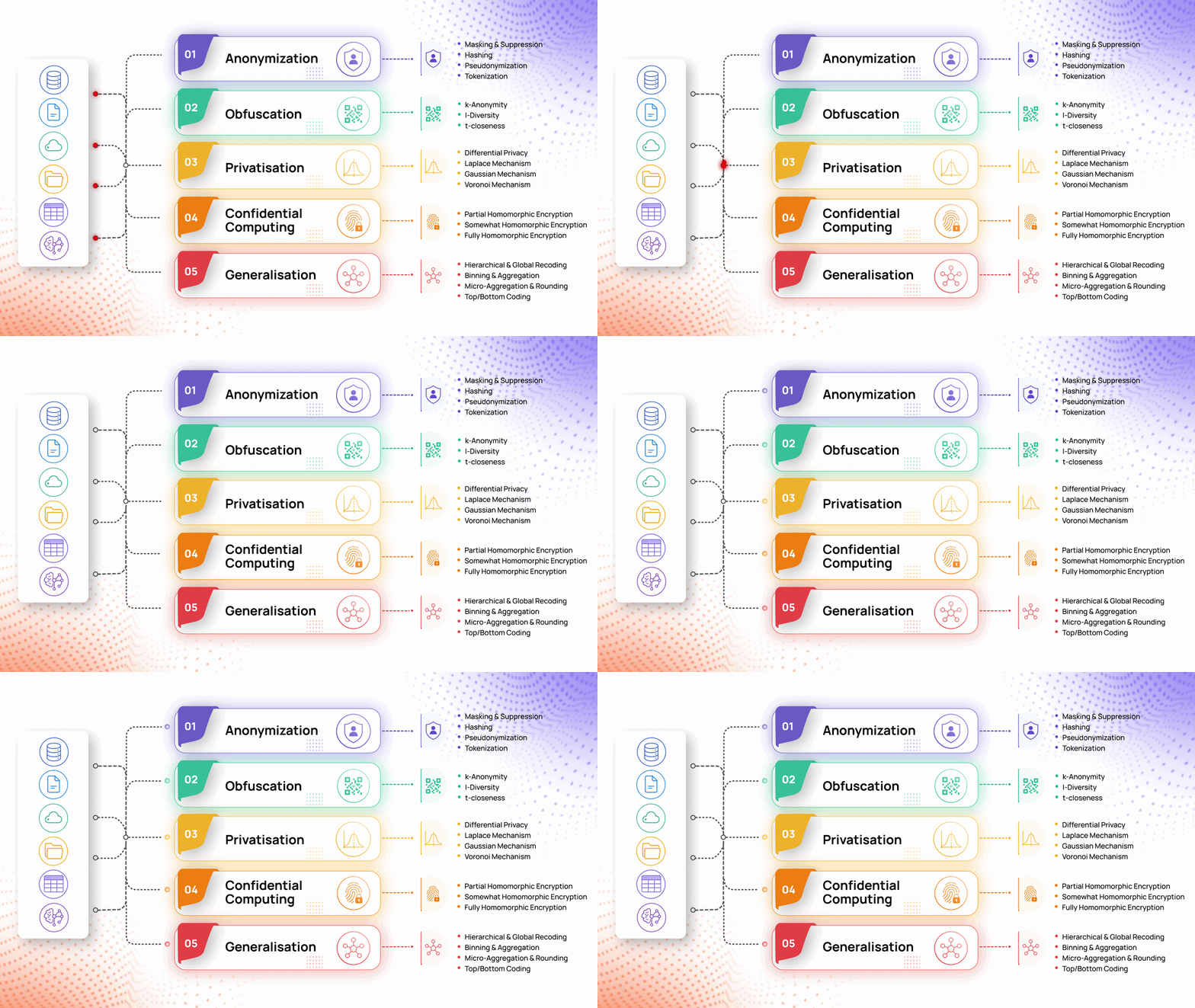
AI and analytics systems are inherently dependent on data access. The more direct the access to raw data, the higher the risk of exposure, leakage, and re-identification.
Xafe redefines this interaction by introducing a controlled interface between data and computation, where privacy is mathematically enforced at every stage.
The platform leverages a combination of Privacy Enhancing Technologies (PETs), including differential privacy, anonymization, obfuscation, and confidential computing. These techniques ensure that individual data points are never directly exposed, while still allowing meaningful aggregate insights to be generated.
Differential privacy forms the core of this capability. By injecting calibrated statistical noise into query outputs or model training processes, the platform ensures that results remain analytically valid while preventing the identification of any individual record.
This is complemented by privacy budget management, where each interaction with the dataset is monitored and controlled. As queries are executed, the system tracks cumulative privacy exposure and enforces limits to prevent data leakage over time.
In parallel, confidential computing techniques such as homomorphic encryption enable computations to be performed on encrypted data. This ensures that sensitive information remains protected even during active processing, eliminating exposure risks across the data lifecycle.
The result is a fundamentally different model of AI and analytics — one where insights are extracted without revealing the underlying data, and where privacy is guaranteed by design rather than enforced through policy.
Federated learning is often positioned as a privacy-preserving approach because it keeps data localized across distributed systems. However, data locality alone does not guarantee privacy.
In standard federated systems, model updates exchanged between nodes can still leak sensitive information through inference attacks, reconstruction techniques, or repeated interactions.
Xafe addresses this gap by extending federated learning with federated privacy, ensuring that not only data remains local, but also that no sensitive information can be inferred from shared outputs.
The platform enforces privacy at multiple levels within distributed environments:
at the source before any computation
during training and update exchange
for analytical and predictive results
Differential privacy is applied to model updates, ensuring that individual contributions cannot be reverse-engineered. Encrypted aggregation techniques further protect data during transmission and model consolidation.
Xafe supports both centralized and decentralized privacy architectures:
Privacy controls are applied during query execution and result generation.
Privacy is enforced locally before data or updates leave the source system.
This ensures that regardless of system design, privacy guarantees remain consistent and enforceable.
By combining federated learning with federated privacy, the platform enables collaborative AI development across organizations without requiring direct data sharing — preserving both data ownership and analytical capability.
Regulatory compliance has evolved from a legal requirement to a core architectural constraint in modern data systems.
Frameworks such as GDPR, PDPB (India), HIPAA, and CCPA impose strict controls on how sensitive data can be collected, processed, stored, and shared. These regulations require not just data protection, but demonstrable privacy guarantees and auditability.
Xafe operationalizes compliance by embedding regulatory requirements directly into system design.
Instead of relying on external governance processes, the platform ensures that data is transformed into a compliant state before it is used. This includes anonymization, privatization, and controlled exposure mechanisms that align with regulatory definitions of data protection.
Differential privacy ensures that analytical outputs meet regulatory standards for anonymization by preventing re-identification, even under repeated analysis or adversarial conditions.
The platform also supports:
These capabilities allow organizations to operate within complex regulatory environments without compromising their ability to use data for AI, analytics, and innovation.
Talk to an Entiovi privacy platform lead. We'll size the team, set up the engagement, and deliver from day one.